
What Delaware County Property Tax Records Contain
No single field explains a bill. The Assessor supplies parcel characteristics and valuation; the Auditor handles the tax duplicate and deductions; the Treasurer collects and reports account status; and DLGF publishes state guidance and county-supplied assessment data.
| Record field | Meaning | Source |
|---|---|---|
| Land and improvement values | Components of gross assessed value | Assessor / Beacon / DLGF |
| Gross, net, taxable value | Value stages before and after applicable deductions | Assessor and Auditor |
| Deductions or exemptions | Approved homestead, mortgage, veteran, disability, or other relief | Auditor / Assessor / PTABOA |
| Tax district | Jurisdictions and levy context tied to the parcel | Parcel card and tax duplicate |
| Bill and payment status | Installments, amounts posted, payments, and delinquency context | Treasurer |
| Tax-sale or redemption status | Whether the ordinary search route may no longer apply | Treasurer, Auditor, Clerk, Recorder |
Assessed value serves a single administrative purpose: taxation. It is not necessarily what a property last sold for. The final bill also depends on deductions, levies, caps, and timing.
Assessor, Auditor, Treasurer, and DLGF Each Hold a Piece
The Beacon parcel application is the practical first stop for Delaware County property records. It shows the owner of record, situs, acreage, parcel number, class, assessed values, and a brief legal description. Its owner and value fields are assessment records, though, not proof of title or a boundary survey.
The Auditor maintains the tax duplicate and deduction and exemption administration. Delaware County material directs deduction questions to the Auditor at 765-747-7717, while exemption filing involves the Assessor, with PTABOA approving or denying. The Treasurer collects tax, keeps payment and tax-sale or redemption information, and offers the eNotices lookup. The DLGF assessed-value search guidance explains the statewide search, detail views, and Excel download built on county-supplied data.
Look Up a Delaware County Tax Bill
The Delaware County Treasurer search takes a parcel ID, owner name, or address in one input. Separate multiple last names with commas. Separate multiple parcel numbers with spaces. For a clean Delaware County property search by owner or address, start with the exact parcel number from Beacon so you avoid matching a similar owner or street.
- Open Beacon and save the compact and dotted parcel identifiers, situs, owner spelling, tax district, and assessment year.
- Enter the parcel ID in the Treasurer search; retry by address or owner only as a cross-check.
- Read the bill, payments, delinquency messages, and any warning that redirects the account out of ordinary public search.
- Compare assessed values and deductions with the Assessor/Auditor record, keeping assessment year separate from bill year.
- Call the Treasurer before relying on a post-due total, payment-fee display, redemption figure, or tax-sale status.
- Assessed value
- The county's value used in the property-tax process, including land and improvements.
- Levy or tax rate
- The rate context applied within the parcel's taxing district.
- Homestead deduction
- Qualified relief that can reduce the taxable base when properly filed and approved.
- Tax lien
- A legal claim arising from unpaid property taxes, requiring official status verification.
The Tax-Sale Warning Changes the Search Route
A parcel may be eligible for tax sale, or it may already have been sold. It might not appear in the ordinary Treasurer search. A missing result is not a clean-tax conclusion. It means you should contact the Treasurer for the right payment, redemption, or sale workflow. Compare Auditor accounting, court proceedings, and recorded tax deeds or notices where they matter. The successful Treasurer portal lookup shows the shared name, address, and parcel field. It also carries this warning.
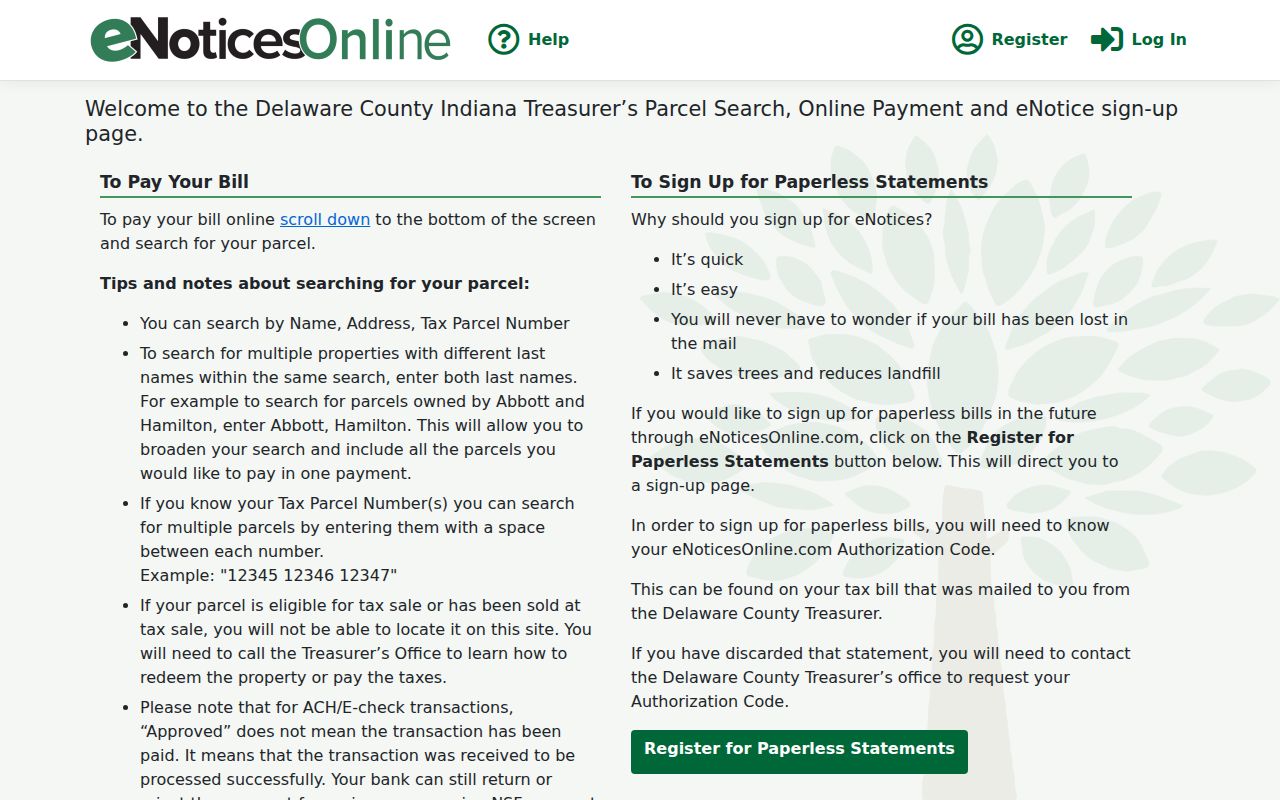
The warning carries a lesson worth keeping. When a parcel drops out of the database, account status may be the reason rather than a missing tax obligation.
Note: Online and telephone payments use jurisdiction code 2414, but confirm current convenience fees and totals directly with the Treasurer.
Match Assessment Year to Tax-Bill Year
Indiana assessment materials separate annual trending and cyclical reassessment from billing. A stated assessment year generally relates to the following tax-bill year. When two screens seem to disagree, check first whether they describe the same parcel, assessment date, tax year, and data-refresh date before doubting the property records themselves.
| Item to save | Why it matters | Best verification |
|---|---|---|
| Assessment year | Dates the valuation record | Assessor notice and parcel card |
| Bill year and installment | Dates the tax obligation and due period | Treasurer bill/payment history |
| Land and improvement values | Shows which component changed | Assessor detail and DLGF data |
| Deductions and caps | Explains difference between gross value and payable amount | Auditor and bill detail |
| Source date | Identifies stale or asynchronously updated data | Saved notice, PDF, or office confirmation |
Verify Delaware County Deductions Separately
Homestead, mortgage, veteran, disability, and other deductions should not be inferred from the amount due. Check the parcel's current deduction record and contact the Auditor about eligibility, filing history, correction, or a missing item. Filing and approval roles can differ: county material says the owner files an exemption with the Assessor and PTABOA approves or denies it.
Ask which form, supporting proof, filing date, assessment year, and parcel identifiers control. Keep a dated copy of the filing and the office response. A recently acquired parcel may still show a former owner's mailing information or deduction status until county records update; do not assume that an old entry carries forward automatically.
Resolve Conflicting Delaware County Tax Records
Start with identity before value. Compare compact and dotted parcel numbers, situs, acreage, tax district, owner mailing address, and the abbreviated legal description. A lot split, combination, correction, annexation, or address change can make two related accounts look inconsistent. So can a portal-refresh gap.
Request the parcel card and assessment notice from the Assessor. Ask the Auditor for the deduction or tax-duplicate record. The Treasurer can supply the bill and payment ledger. If a court or tax-sale event appears, retrieve the docket from MyCase. Verify any recorded tax deed, lien, release, or order with the Recorder of deeds. Indiana APRA, IC 5-14-3, supports a specific inspection or copy request subject to statutory exceptions. Name the record you want. Avoid asking an office to answer a broad legal question.
Appeal a Delaware County Assessment
DLGF materials describe the Form 130 route. You begin the assessment appeal, take part in the assessor's informal conference, and proceed to the Property Tax Assessment Board of Appeals if unresolved. An Indiana Board review path exists when applicable. An appeal contests valuation only. It does not decide deed ownership or survey boundaries.
Build the evidence file before the deadline on the current assessment notice. Include the parcel and year, the disputed land or improvement component, property-characteristic errors, comparable evidence, photographs or contractor information where relevant, and copies of the notice and card. Confirm the current filing trigger, form version, delivery method, and deadline with the Assessor, because no single universal Delaware County calendar date applies to every appeal.
Appeal window. File Form 130 by the deadline printed on the applicable notice or otherwise supplied for that assessment cycle. Confirm timing with the Delaware County Assessor; missing it can postpone review.
What a Tax Record Does Not Establish
A Delaware County tax record settles certain questions and leaves others open. It does not prove title. It cannot fix a legal boundary, clear liens, or state what a property actually sold for. The owner of record on the tax roll can lag behind the newest recorded deed. A GIS line is not a survey. A summary screen may hide penalties or credits that change the amount due. For ownership and encumbrance instruments, turn to Delaware County deed records, and treat parcel maps as geographic finding aids rather than legal proof.
Before acting on a purchase, an estate, an appeal, or a tax-sale decision, preserve the source dates. Confirm the key figures with the custodian responsible for the record. Keep your work tied to the parcel itself. Avoid republishing personal details pulled from owner-mailing or payment records that the situation does not require.
Put New Delaware County Data in Context
New data releases deserve a careful read. A Spring 2025 county Surveyor newsletter described expanding GIS use. Indiana's December 18, 2025 GeoInsights release described a statewide harvest of parcels and administrative boundaries. Either can be useful for comparing a Delaware County extract against statewide data. Neither promises that every value, owner field, or geometry matches the current county card.
Before treating a downloaded parcel record as authoritative in a property tax review, save the service, layer, filter, field definitions, source date, and assessment year alongside it. Then compare it to the Beacon card. Also check the Treasurer's bill. Only then should a difference be read as a valuation change. The local record and its appeal timetable control the outcome. The apparent freshness of an open-data file does not.
Note: newer does not mean more accurate; the county's own assessment year governs.
Build a Delaware County Tax Worksheet
Place the parcel ID, assessment year, bill year, land value, improvement value, gross assessed value, approved deductions, net or taxable value, district, installments, payments, penalties, and source dates on one worksheet. This separates a valuation dispute from a payment-posting issue and shows which office can correct the underlying record.
If land or building characteristics are wrong, take the parcel card and evidence to the Assessor. If a deduction is missing, preserve the filing and contact the Auditor. If a payment or total is wrong, use the Treasurer's ledger and receipt. A title-name mismatch should be checked against the newest recorded deed rather than “corrected” from a tax screen alone.
For parcel changes, ask for the split, combination, or transfer history and note which account carried each assessment and bill. Do not add the balances of old and new parcel numbers without confirming their effective dates; overlapping portal rows can describe successive records rather than simultaneous obligations.
Separate Delinquency from a Completed Transfer
A delinquent amount, tax-sale eligibility, a sale event, redemption, and a recorded tax deed are distinct stages. The Treasurer and Auditor supply account and sale context; the Clerk or court may hold related proceedings; the Recorder preserves instruments that affect recorded ownership. Search all relevant names and the parcel's legal description before concluding that a tax event changed title.
When an account disappears from the normal search, call with the parcel number, owner spelling, sale year, and bill in hand. Request the precise status, payoff or redemption procedure, and records identifying the next step. Any deadline or amount should come from the current official notice or office response, not from an undated portal summary.